THE PERPETUAL VIRGINITY OF MARY
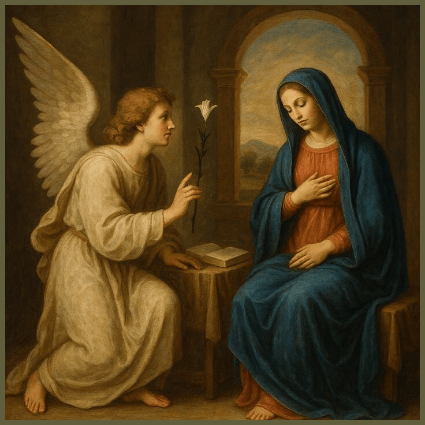
Behold thou shalt conceive in thy womb, and shalt bring forth a son; and thou shalt call his name Jesus. He shall be great, and shall be called the Son of the Highest; and the Lord God shall give unto him the throne of David his father; and he shall reign in the house of Jacob forever. And of his kingdom there shall be no end. And Mary said to the angel: How shall this be done, because I know not man? And the angel answering, said to her: The Holy Ghost shall come upon thee, and the power of the Most High shall overshadow thee. And, therefore, also the Holy which shall be born of thee shall be called the Son of God.
Luke 1, 31-35
If a fortune teller were to inform us that we would die of lung cancer from smoking at some unspecified time in the future, we might question how that could happen since we do not smoke. We could clarify our position by saying, “How can this be, since I don’t smoke?” Additionally, we could ask, “How could I possibly die of lung cancer? Is it because I am going to start smoking after all?” Mariologist Father René Laurentine, in his interpretation of Luke 1:34, notes that the phrase “I do not know” should be understood as relating to a condition rather than just a specific moment in time. For instance, if someone is offered a cigarette and responds, “I do not smoke,” it is generally understood that they mean “I never smoke” and “I am not smoking now.”
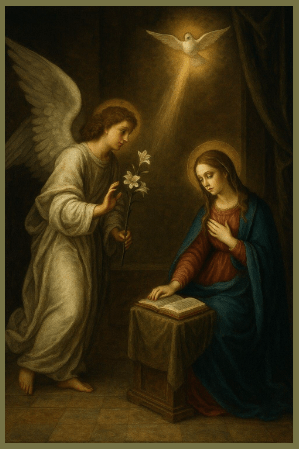
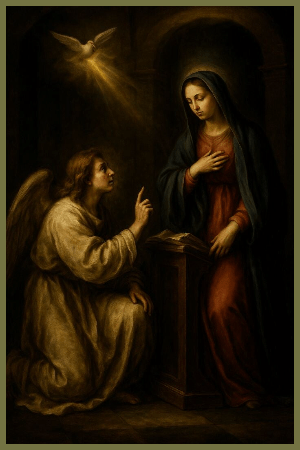
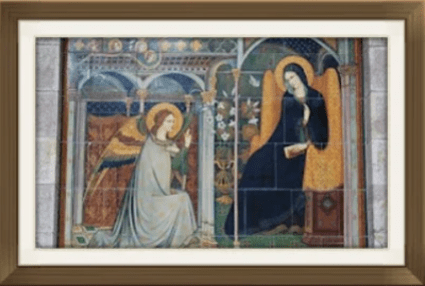
At the Annunciation, the Virgin Mary is perplexed when the angel Gabriel announces that she “will conceive and bear a son.” Her confusion is understandable, as she is a virgin and intends to remain one for her entire life. Like a non-smoker concerned about the unknown, Mary anxiously asks the angel, “How shall this be done, since I do not know man?” She is eager to understand how she will have a son, especially since she does not plan to engage in sexual relations with any man she might marry. Mary likely wonders if she and her betrothed will have a conjugal relationship after all. In response, the angel reassures her, explaining that the child’s conception and birth will be supernatural. He tells her that the power of the Highest will overshadow her and, as a result, her Son will have a holy, Divine origin (Lk 1:35).
The original Greek text reads andra ou ginosko (ἄνδρα οὐ γινώσκω), which says “man not I know” or in English, “I know not man.” The Greek verb ginosko (Present Indicative Active) is in the continuous present, which shows a permanent disposition not to know man. ₁ The original Greek translates what Mary says to the angel in her native tongue of Hebrew-Aramaic: ‘ki enneni yodaat ish.’ The Greek present tense used for Mary’s words in Luke 1:34 corresponds to the Hebrew Aramaic active participle (yodaat), indicating a permanent condition. ₂
Mary has a lasting disposition not to have sexual relations with a man, similar to the way someone who says, “I don’t smoke,” has a permanent disposition not to smoke. In the Scriptures, the verb “to know” is often used as a Jewish idiom for sexual relations between a man and a woman. Essentially, when Mary speaks to the angel, she is conveying that she does not have sexual relations with a man. So, she wonders how she will conceive Jesus. She tells the angel, “I do not have sexual relations with a man.” She has never engaged in sexual relations, nor is she currently doing so. Mary’s situation is similar to that of a non-smoker who has a consistent decision not to smoke. It is Mary’s enduring choice and commitment not to have sexual relations with a man that leads her to question the angel about how she could possibly conceive and bear the Messiah, given her situation.
The King James Bible translation is accurate because the verb “to know” is in the Present Indicative Active. Still, it is misleading with the insertion of the indefinite article “a” before “man”, which we don’t have in Jerome’s Latin Vulgate. Including this grammatical exponent can create a misunderstanding of God’s written word. The object in Mary’s statement is andra (ἄνδρα), which means “man” or, more precisely, the gender of the male sex. It does not signify an individual male, who in this case would be Joseph. ₃
The KJB discrepancy may extend to modern readings such as “I do not have a husband.” However, we read in Luke 1:27 that Mary was betrothed (espoused) to Joseph at the appointed time. The couple was already legally married, having observed the first part of the marriage ceremony (Kiddushin), which included signing a legal marriage contract. They were, in fact, husband and wife at the time of the Annunciation, which explains why Joseph could divorce Mary as soon as he discovered she was with child (Mt 1:18-19). The object noun andra can mean “husband” in a general sense (Jn. 4:17), but Mary does not say, “I have no husband,” since she already has one whose name is Joseph. The exponent andra does not refer to individual men. There is another word for them: anthropos (ἄνθρωπός), as in Matthew 8:9. ₄
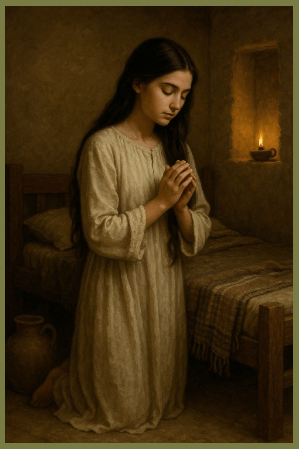
Augustine of Hippo reasons that Mary must have already consecrated herself to God and vowed to remain a virgin all her life while serving in the temple as a young girl (Of Holy Virginity). There is testimony to the existence of temple virgins in Jewish traditions. In the Mishnah, it is recorded that 82 consecrated virgins wove the veil of the Temple: “The veil of the Temple was a palm-length in width. It was woven with seventy-two smooth stitches, each made of twenty-four threads. The length was forty cubits, and the width was twenty cubits. Eighty-two virgins wove it. Two veils were made yearly, and three hundred priests were needed to carry them to the pool” (Mishna Shekalim 8, 5-6). Rabbinic Jewish sources also record how, when the Romans sacked Jerusalem in AD 70, the Temple virgins leaped into the flames so as not to be abducted by the heathen soldiers: “The virgins who were weaving threw themselves in flames” (Pesikta Rabbati 26, 6).
Judaism generally does not support marital celibacy, as marriage is considered a normal state and a divine ordinance. However, some marginal sects within the Jewish tradition, such as the Therapeutrides, Essenes, and Qumran community, had exceptions to this rule against celibacy. Even Rabbinic Judaism made exceptions for those dedicated to Torah study. Jesus and his close relatives were associated with a Jewish sect called the Essenes, and within this group was a sub-group called the Nazarenes, which means “keepers of the covenant.” The Upper Room, where Jesus held the Seder meal (the Last Supper) with his apostles, was located in an Essene neighborhood in Jerusalem.
Moreover, the Protoevangelium of James is a significant document that supports the belief in Mary’s perpetual virginity. This text, believed to have been written around AD 120, emerged less than 60 years after Mary’s death, ensuring that her contemporaries’ memories of her life remained vivid. In this document, it is recorded that when Mary’s birth was predicted, her mother, St. Anne, made a vow to dedicate her daughter to the service of the Lord, similar to the vow made by Samuel’s mother (1 Samuel 1:11). Consequently, Mary was intended to serve at the Temple, aligning with the traditions of women who had fulfilled similar roles for centuries (1 Sam 2:22). This tradition can also be observed in the life of Anna the prophetess during the time of Jesus’ birth (Luke 2:36-37). Due to her commitment to a life of continuous service at the Temple, Mary chose to live a life of perpetual virginity rather than pursuing a typical role as a mother.
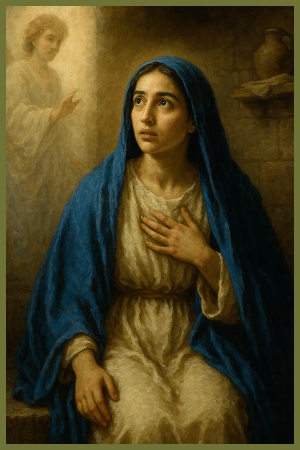
In any event, Mary asserts that she does not have sexual relations with a man, and this statement encompasses a time frame that includes the future simple tense. Luke presents Mary speaking in the present tense, using an active voice and indicative mood, because the angel does not imply that she has conceived or will conceive at any specific time. The crucial point is that she does not have sexual relations with any man, including her husband. This absence of sexual relations defines her identity as a virgin. The verb tense indicates an ongoing state of not having sexual relations with a man, extending beyond the present moment into the future. Confused, Mary reiterates that she does not have sexual relations with a man—now or ever—despite the angel’s announcement.
Indicated by the present active voice, Mary’s condition is an objective fact that Mary asserts continues beyond the present moment and into the future, including when she is supposed to have a son. The angel’s announcement that she will conceive and bear a son conflicts with her unchanging, ongoing state. This explains her perplexity. The conjunction since serves as a logical connector. The Greek exponent epei (ἐπεί) ₅, in this case, can be paraphrased as because: Because Mary does not have sexual relations with a man, including her husband, she wonders how she will conceive and bear a son. We mustn’t presume that this adolescent of marriageable age knew nothing about human biological reproduction.
The indicative mood of the verb ‘to know’ indicates Mary has no intention of having conjugal relations with her husband, Joseph, regardless of what the angel says. For this reason, she can’t possibly be the mother of the expected Messiah unless God has other plans for her that she is presently unaware of. The angel Gabriel reveals the Divine intention to Mary in the following verses. Only then does she pronounce her Fiat without further ado, and the angel departs (Lk 1:38).
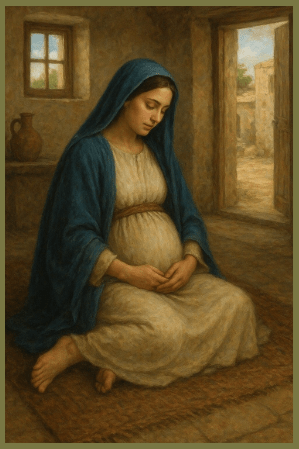
Therefore, we should remember that the verb “to know” in the first person (ginosko) does not have to do with an instant of time but rather with Mary’s state itself. Mary does not tell the angel that she does not have relations with a man (her husband) now, or that she has not had any sexual relations with him until now. There would be no reason for her to say these things since the angel does not tell her that she has conceived or suggest even remotely that she will conceive the child immediately or before her marriage is formally solemnized upon the second and final wedding ceremony (Nisuin). The original Greek text reads: “I do not know man.” Mary has sexual relations with no man ever – not presently, not ever. And since the verb is in the active indicative mood, there is an emphasis on the progress of the negative action (not to know a man), which continues when she is supposed to have the child – whenever that will be.
The Greek present tense denotes either a progressive or repetitive action. In this case, it is progressive and indicates a continuance of a state that bears on a future event. So, there is an emphasis on the progress of an action (does not know or have sexual relations with a man) or a state (virginity) that extends into the future and embraces it. The verb “to be” (estai / ἔσται) is in the simple future tense. ₆ Mary’s present state in real-time is of no concern.
“ki enneni yodaat ish.”
So, it isn’t a question of whether she has had relations with her betrothed until now or has relations with him when she shouldn’t. The question is whether a woman who does not have sexual relations with a man can ever conceive and bear a son. The angel explains how in the following verse: “The Holy Spirit will come upon you, and the power of the Highest will overshadow you.” There is something about Mary that Luke wishes to give testimony to, that she is perpetually a virgin. If ever there were a conclusive Scriptural proof text for the Catholic dogma of the Perpetual Virginity of Mary, it would have to be Luke 1:34: “How shall this be done, because I know not man?”
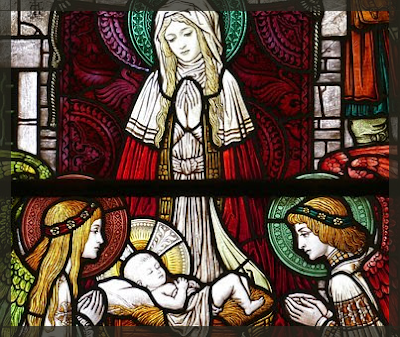
Therefore, the Lord himself shall give you a sign.
Behold the virgin shall conceive, and bear a son,
and his name shall be called Emmanuel.
Isaiah 7, 14
Early Sacred Tradition
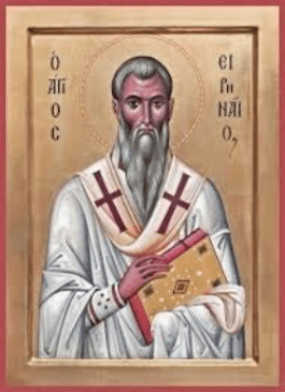
St. Irenaeus (A.D. 180-190)
Against Heresies, 4, 33, 12
“The Word will become flesh, and the Son of God the son of man–
the Pure One opening purely that pure womb,
which generates men unto God.”
Tertullian (A.D. 213)
On Monogamy, 8
“And indeed it was a virgin, about to marry once for all after her delivery,
who gave birth to Christ, in order that each title of sanctity might be fulfilled
in Christ’s parentage, by means of a mother who was both virgin, and wife of one husband.”
Origen (A.D. 232)
Commentary on John, I:6
“For if Mary, as those declare who with sound mind extol her, had no other son but Jesus,
and yet Jesus says to His mother, Woman, behold thy son,’ and not Behold you have this son also,’ then He virtually said to her, Lo, this is Jesus, whom thou didst bear.’ Is it not the case that everyone who is perfect lives himself no longer, but Christ lives in him; and if Christ lives in him, then it is said of him to Mary, Behold thy son Christ.’”
St. Athanasius (A.D. 362)
Orations against the Arians, II:70
“Therefore let those who deny that the Son is from the Father by nature and proper
to His Essence, deny also that He took true human flesh of Mary Ever-Virgin;
for in neither case had it been of profit to us men, whether the Word were not true
and naturally Son of God, or the flesh not true which He assumed.”
St. Ambrose (A.D. 396)
To the Christian at Vercellae, Letter 63:111
“Imitate her, holy mothers, who in her only dearly beloved Son set forth so great
an example of maternal virtue; for neither have you sweeter children,
nor did the Virgin seek the consolation of being able to bear another son.”
St. Augustine of Hippo (A.D. 411)
Sermons 186:1
“It was not the visible sun, but its invisible Creator who consecrated this day for us, when the
Virgin Mother, fertile of womb and integral in her virginity, brought him forth, made visible for
us, by whom, when he was invisible, she too was created. A Virgin conceiving, a Virgin bearing,
a Virgin pregnant, a Virgin bringing forth, a Virgin perpetual.
Why do you wonder at this, O man?”
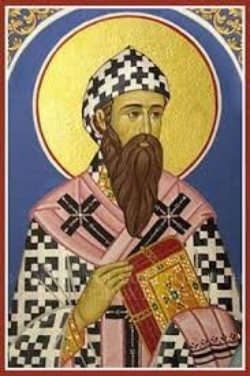
St. Cyril of Alexandria (A.D. 430)
Against Those Who Do Not Wish to Confess
That the Holy Virgin is the Mother of God, 4
“The Word himself, coming into the Blessed Virgin herself, assumed for himself
his own temple from the substance of the Virgin and came forth from her a man in all
that could be externally discerned, while interiorly he was true God. Therefore he kept
his Mother a virgin even after her childbearing”

SALVE REGINA CAELI
Notes & Sources
[1] James H Strong, Strong’s Exhaustive Concordance of the Bible [1097. Ginosko] Verb – Present Indicative Active – 1st Person Singular. A prolonged form of a primary verb, to ‘know’ in many applications and with many implications. [UK: Hendrickson Publishers, 2009]
[2] Manuel Miguens, OFM, The Virgin Birth: An Evaluation of Scriptural Evidence (Boston: St. Paul Edition, 1981), 81.
[3] Strong’s Exhaustive Concordance of the Bible [435. Andra] Noun – Accusative Masculine Singular. A male human being; a man, husband (in general). A primary word is a man.
[4] Ibid., [444. Anthropos] Noun – Nominative Masculine Singular. A man, one of the human race.
[5] Strong’s Exhaustive Concordance of the Bible [1893. Epei]
[6] Ibid., [1510. Eime] Estai is the simple future tense (“will be”) form of the original present tense verb eime, which means “to be” or “to exist”.


Leave a Reply